intrinsically safe radios

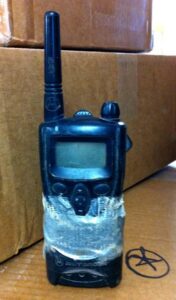
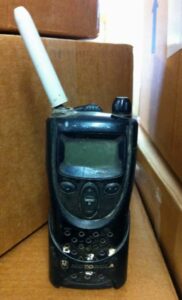
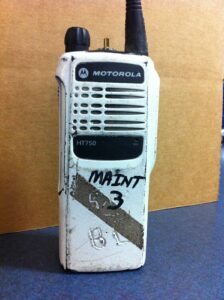
Motorola HT750 repairThis Motorola HT750 we’ll call “Old Paint” came in for repair in 2013. It and 2 others from a manufacturing plant had been customized with painted housings. It was quickly recognized during the check-in process that the radios were marked as intrinsically safe (I.S.). A call was made to the customer to see if they needed the radios to remain I.S. Yes, they did. So Delmmar Communications forwarded them to the Motorola repair depot for factory service. As of this writing, the manufacturer of I.S. rated radios are the only repair depots certified to repair them. In the event the customer does not need the radio to be intrinsically safe it can be repaired at Delmmar’s radio repair center.

Intrinsically safe is a protection technique for safe operation of electrical equipment in hazardous areas by limiting the energy available for ignition.  Areas with dangerous concentrations of flammable gases or dust are found in applications such as petrochemical refineries and mines.

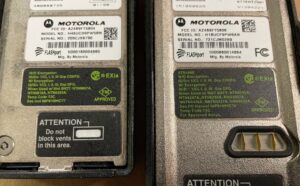
When businesses work around hazardous areas, I.S. radios are required. Radios manufactured to be intrinsically safe are labeled with green “FM approved” or white “UL”  labels.I.S. sticker

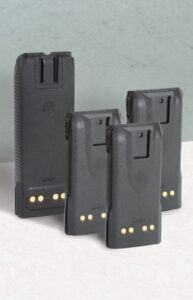
Users of I.S. radios must also use I.S. rated batteries and audio accessories.

Delmmar Communications offers a full line of intrinsically safe radios. If your company works in an area that requires I.S. radios, give us a call, 800-872-2627, when you need additional radios or radio repair. We are happy to help, and can facilitate getting radios to the factory repair depot.


adventurous

fictional story with some facts mixed in
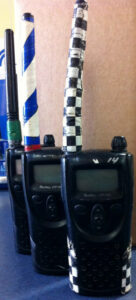
Motorola CP100 at radio repair centerOur normal day is a life of adventure, the thing most radios only dream about.  Our company ad says: “Learn the ropes of rock climbing from our expert staff. Soar through the air with one of our professional trapeze artists. Trek through the woods on a mountain bike. And don’t miss out on the opportunity to zoom through the trees on one of our many zip lines. Your next adventure is ready and waiting.”  Me and my buddies are a pretty extreme sport crowd. We’re livin’ the dream! Nothing like zipping through the tree canopy riding on the hip of one of the adventurers. Ah… this is the life!

So here we were on a fine Summer afternoon hangin’ out with the cool crowd at the resort, zippin’ along through the trees, when suddenly my clip became dislodged from my guide’s belt and I began to tumble end over end to the floor of the forest. Luck for me the guide noted approximately where he had dropped me. A group of fellow guides on the ground swiftly began searching for me among the green vegetation. I waited staring up at the blue sky peaking through the tall branches.  Occasionally I would hear them talk into their radio to see if they could hear my speaker respond. My ability to receive transmissions and speak out must have been quieted by the fall. All I could manage was a distorted mumble. So every opportunity I had I would mumble.  Eventually, using their keen tracking skills they located me in my soft cushion of grass.

When it was discovered I was mumbling, they must have thought I had a concussion, and they took me to the office. I sat there on desk in a box with several other radios listing to the phone calls, office chitchat, and a noisy copy machine. I longed for the outdoors. I decided… the office was boring. Or maybe it is just boring to a radio of adventure like myself. I just wasn’t cut out to be an office radio.

Soon I overhear them talking about me and some others needing to go to a radio repair facility. By the next morning we were in a box, riding in a truck on our way to Missouri. One of the other radios had been there before, and said it will take about 3 days in the dark to get there. We might as well get some rest. Well sleeping worked for a while, then I was wide awake. As we passed through cities we could occasionally hear someone talking on their two-way radio through our receivers that were left turned on. The journey seemed longer since it was in the dark.

Then on day three we arrived at the repair facility. The lights were bright when the box was first opened. A friendly girl with a nice voice took me out of the box and put me in a brightly colored bin with the others from the resort. She read the note the guide had written and taped to me. She spoke out loud and said “this one has poor receive”, as she admired my customized exterior.

The guide who uses me most had decorated me with checkered flag duct tape. I figured it was because he and I together are so fast at all the sports. No team can zipline as fast as us, or climb the rock mountain so quickly. We don’t have race cars at the resort, but if we did, we would likely be among the fastest on the track. Some of the others in my group also had some customization. A radio nicknamed Green had a simple piece of green tape around his antenna, and another one had blue and white racing stripes. You could tell we were not the office radios, we are the extreme sport radios.

At the repair center we could feel the looks of the other radios as they admired our sporty look. While some radios had their company name emblazened on them, or a fruit sticker on their front, we were like a flashy sports car ready for the race. Our bin made its way through the repair facility and on to the technicians bench. He took great care in returning us to working order. Soon I will be headed back to Connecticut ready for my life of adventure. I’m dreamin’ now about zippin’ through those trees, climbing the rocks, can’t wait to be home.

If you have questions about 2-way radio repair give us a call here at Delmmar Communications, 800-872-2627. We are always happy to help.

~cl
ahh the life (expectancy)

2-way radio batteriesSigns of a bad, defective, or aged battery include constant or intermittent static, a shorter work day, and intermittent or poor transmit. Transmit problems are an early indicator of a old or bad battery. It is simple, it takes more energy to transmit than to receive. So if you have a radio that receives perfectly, but is iffy on transmit, check your battery.

So then the question arises… What happens if I continue to use the old battery? Just like any home appliance operating on low voltage, your radio will eventually have failures associated with the brown out. Then the simple need for a replacement battery turns into a battery + radio repair. As you can see, it would be much cheaper and wiser to replace the old battery when needed.Motorola battery date code

How do you know the age of a battery?

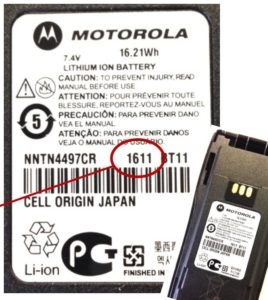
On Motorola brand batteries you will find either a 3-digit code or 4-digit code on the label of the battery or embossed in the plastic of the battery itself.  (See above photo for an example.) The first number on the 3-digit code represent the year of manufacture, the next two numbers are the week of the year. Example: 611 would be 2016 (or heaven-forbid 2006) the 11th week of the year. The newer 4-digit date codes are easier, 1611 would be 2016, the 11th week.

If you have difficulty determining the age of a battery, give us a call here at Delmmar Communications, 800-872-2627. We are always happy to help.

in the dark

radio fiction with a little bit of facts sprinkled in

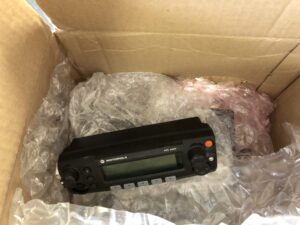
Here I am, all alone in a box, rattling along on my way to the Radio Repair Center. John, my buddy, who uses me everyday is on vacation for a week. And what does he do? He packs me in a box and sends me on my way. I know I’m a little older now. My body has a few nicks and scratches. I am sometimes a little hard of hearing too. John thinks I need a tune-up. This box sure is dark, and it seems I’ve been in here for a few days. First on a truck, then a conveyor belt, then another truck. Lots of jiggling and jostlingMobile radio in a box.

First moment of light comes into the box, and here is a the friendly face of the Radio Check-In person. She examines me and puts me in a bright yellow tub to ride through the repair facility. As I look around, I see lots of yellow tubs with other radios riding like little soldiers standing up in a row. Some look old, some look young. As I wait my turn in line night falls.

When morning comes the technician takes me to his bench. The bench is full of tools, gadgets, and electronic test equipment. He swiftly removes my outer housing and looks at my component board. His computer softly plays music in the background as he replaces several parts on my component board. That soldering iron can be pretty hot, but I’m tough, I can take it.

Pressing my PTT button he whistles and speaks a-u-d-i-o–a-u-d-i-o. His voice is now crystal clear. Just as swiftly as he removed my housing, he puts one back on. One final test and then back in the yellow bin I go.

As I am being carried back to the front of the shop, I catch a glimpse of my reflection in the glass of the window. I have a new housing. I look all young and new again.  The time comes and I am back in a box riding home from my adventure. Sure will be good to see John again. Hope he recognizes me in my new clothes!

If you have questions about radio repair give us a call here at Delmmar Communications, 800-872-2627. We are always happy to help.

construction grade radio

CP200 and CP150 portable radios

Hardworking, durable, tough, will take a drop, these are all phrases we hear when people are talking about the CP200. It is the best choice in the mid-tier of Motorola radios. It is an all around construction grade radio. It is the replacement radio for the SP50, P110 and P1225 radios in the former Radius Division, now Commercial Series for Motorola. It durable 40-hour a week working radio, has a full two year factory warranty, and comes equipped with both a long-life Li-Ion Battery and a Fast Rate Desktop Charger.

Flat rate radio repair is available for the CP200 after it is out of warranty. Includes parts, labor and return shipping.

Note: The CP200 radio has been replaced by the CP200d, which is available in digital or analog only models.

If you have questions give us a call here at Delmmar Communications, 800-872-2627. We are happy to help.

special modifications


Occasionally radios arrive at our Motorola CP100 with duct taperepair facility with some unique modifications. These two CP100 UHF radios arrived together from one of our very favorite nursery companies. They were just so special we thought we’d take a picture or two and blog about them.

The first radio is a classic example of a radio with poor transmit and receive, caused inadvertently by the user. Both the microphone hole and the speaker grill are covered by duct tape. We can see the reason for the duct tape engineering, the carryholder was broken, and the user wanted the radio to stay in the carryholder. However, in doing so, they blocked the transmit and receive of the radio. Radio lesson: Be watchful when applying tape or stickers to the front of a radio. You might be covering up something you will need.

Motorola CP100 with sharpie antennaThe second one had lost its antenna covering and the user had fashioned a Sharpie pen cartridge to cover the coil. Now while this might be all the rage in the Sharpie fashion world, it is a very temporary fix for the problem. This radio would begin to lose range due to the coil being exposed to the outside elements. Little by little the coil would oxidize and/or corrode, until the radio’s transmit and receive would be shortened dramatically. So if you need to do this for a day or two, great, but then follow it up by getting the radio to the repair repair center and a new antenna installed. 2022 note: Replacement parts are no longer available for the original CP100 radio. Check with us for availability of batteries, chargers, and carryholders.

If you have questions about radios or radio repair give us a call here at Delmmar Communications, 800-872-2627. We are always happy to help.


2022 note: Replacement parts are no longer available for the original CP100 radio. Check with us for availability of batteries, chargers, and carryholders.

The replacement radio for this model would be the CP100d, CP185 or BPR40d.

tidy up workspace

It seems offices become more cramped and cluttered over time. I find we start to surround ourselves with items we might need someday versus the items we truly need for work. Periodically it is necessary to take a good look at the space and declutter, getting rid of items which are obsolete, seldom/never used, or items which can be stored elsewhere.Motorola Multi-Unit Charger

One nifty way to tidy up your radio chargers is a multi-unit charger. When you have multiple single unit chargers and all their cords running amuck, you can take up some space, not to mention many electrical outlets. Most radio models have multi-unit chargers available. These gang chargers typically hold up to 6 radios, and consist of a main unit with 6 radio cups, and a power supply. A variety of options are available, everything from a basic model to the fancier battery maintenance systems with digital displays.

Motorola has a smart energy system charging system named Impres

Motorola has a smart energy system charging system named Impres which It’s the ultimate in battery recharging. When coupled with the Impres batteries the charger will keep track of each individual battery and automatically condition the battery when needed. This adds to the length of time a battery will last, saving you time and money.

Now would be a great time to tidy up your workspace and save money on the gang charger you need. If you have questions about which gang charger would go with your radios give us a call here at Delmmar Communications, 800-872-2627. We are always happy to help.

heavy radio use

It’s that time of year when radios are going to be put into heavy use

Many businesses are now in their busiest season, while others are just gearing up, 2-way radios are getting heavy use. Now is a good time to assess what you have, checking over your radios, batteries, chargers, etc.

Do you have radios that are in need of battery replacement Motorola Impres Batteriesor maintenance? A quick check of the battery and charging system can save many headaches done the road. You probably don’t need reminded, but something as simple as cleaning your battery contacts with a pencil eraser can improve your chargers’ efficiency.

TIPS:

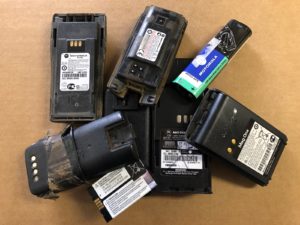
Swapping a known-good battery into a troubled radio can let you know if you have a battery or charging problem. Another piece of advice is to check your battery date codes.  The life expectancy of a NiCd battery is 18-24 months, NiMH and Li-Ion are around 14-18 months. If you have good charging habits and treat your battery well, you may get up to 3 years. At the end of the battery’s life you will start to experience problems with the radio such as static, short business day, no or intermittent transmit. If you use an old battery long enough, it will eventually begin to harm the radio, resulting in a need for repair. Simply replacing an old battery would be about half the cost of a radio repair. Our advice… don’t ignore battery date codes.Motorola battery date code

Chargers take their share of punishment. It is wise to assess your chargers when you are check your batteries. Look in the charger cup, do you see dirt and debris? If so, clean it out with a soft cloth, followed by gently cleaning the charge contacts with a pencil eraser. Check your wall transformer, they are known to burnout much a like a light bulb. When replacing charger transformers keep in mind they are not mix-n-match, you must use the appropriate transformer for the charging tray. Replacement chargers and individual components are usually available for most radio models.

Ever think your radios’ range is getting poorer? Check your antenna. If you can see copper coils when you bend the antenna, or if the top cap is missing, you need to replace the antenna. Use the correct antenna for the radio. The original antenna which came with the radio was designed to work with the radio. Swapping antennas can cause range problems, or result in the need for repair. Some model radios have stubby antennas available, keep in mind these can reduce your range by up to 2/3s. If most of your work is nearby, they may be a good option. However, if you do a lot of work at the edge of your full range, stay away from stubby antennas.

In the event, none of these tips seem to alleviate your radio issues, your radio may be in need of the radio repair center. We have a radio repair form that is easy to fill out. Just put it the box with the radio and we will get the unit repaired and back home to you. We offer a 5-7 day turnaround on most models.

If you have questions give us a call here at Delmmar Communications, 800-872-2627. We are always happy to help.


2-way radios vs cellphones

Cellphone vs Radio

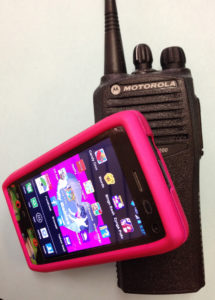
Non-radio users often ask why would someone use a radio instead of a cellphone. Here a few answers:

1) When you need immediate ability to communicate on-site to one or many at the press of a button. Two-way radios are the most reliable method.

2) No monthly bill. No minutes. (unless you connect your radios with a trunking tower system)

3) Durability. Business radios are designed to go a 40-hour work week. Many are rated for resistance to moisture, dust, and humidity. They are made to be a workhorse.

4) Using handheld radios for on-site communications can keep workers on task, and prevent the abuses seen with cellphones. (No calling home or surfing the web on a 2-way radio.)

5) Longer life expectancy. Most cellphones last 2-3 years at best. Business two-way radios typically last 5-7 years, or even longer if you have them serviced as needed.

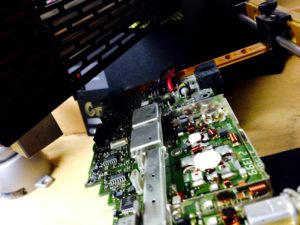
2-way radio board6) Business radios are usually repairable at the radio repair center for less than half the cost of a new radio, while cellphones usually require replacement.

These are just a few thoughts to ponder.

There are situations where cellphones are ideal. But in the situation of public safety, business or on-site communications, radios still give you the best all around solution.

If you have questions give us a call here at Delmmar Communications, 800-872-2627. We are always happy to help.

more tips on better range

2-Way Radio CustomerHere at the radio repair center we get many questions about radio range (talk distance). Typically a handheld business radio will do 2 miles line-of-sight or as far as the radio can see. Several factors interfere with range, including but not limited to: curvature of the Earth, obstacles, height and placement of antenna, position of the radio, and using the correct antenna for the radio.
Range tips:

  • 1) Holding the radio upright with the antenna straight up gives you the best range. Tilting to the side, as if talking on the phone, will reduce the range by up to 2/3s. This will cause transmissions to drop out, or be very staticky. Just remember: Perpendicular to the ground is best!
  • 2) The body fluid of the person wearing the radio can absorb part of the range.  If you’re a little bit round in the middle, your radio will not work as well as your pencil-thin co-worker. You can compensate by wearing the radio higher your body. Maybe in a shirt pocket or with a chest pouch. Height and placement of antenna determines range.
  • 3) Use a good quality fully charged battery. It takes more energy to transmit than to receive. Using a good battery will do wonders to clear up static, making your transmissions clear.
  • 4) Use the appropriate antenna for your radio. While stubby (short) antennas may be available for your radio model, keep in mind these will significantly reduce range. If you are working in a close proximity, they may work wonderfully. However, if you are expecting to transmit a long distance, go back to the original standard length antenna.
  • 5) Check your antenna for damage. If you can bend the antenna and see the coils or if the top cap is gone, it is time to replace the antenna. This may do wonders for your range.
  • 6) Get your radio tuned up. Electronic components inside your radio age over time and the radio will not function as well as it did new. Getting your radio tuned and realigned will bring it back to factory spec, or as close as one can get with an older radio.

If you have questions about increasing range, give us a call here at Delmmar Communications, 800-872-2627. We are always happy to help.