poorly charging battery
It’s a common phone call, “my battery won’t hold a charge” or “my battery won’t take a charge”. One fast and easy tip: Clean your battery contacts, both on the radio and charger, with a pencil eraser. This will clean off the day to day grime and film, allowing your radio to make better contact with the charger. Refrain from using any alcohol or cleaners, which may cause a film to develop.
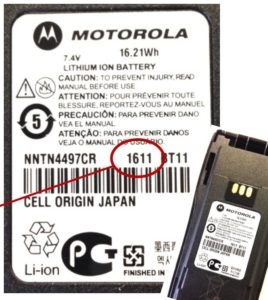 If you are still having difficulties, check your battery’s age. There should be an easy to read date code on the label. For Motorola brand batteries this will consist of a 3- or 4-digit number. On the 3-digit date code the first number represents the year and the next two numbers are the week of the year of manufacture. On the 4-digit codes the first two numbers are the year, followed by the week of the year. Example: 1611 would be 2016, the 11th week.
Battery life depends on the chemistry and how you treat it.
A typical NiCD battery will last 18-24 months before needing replaced. (NiMH 14-18 months, Li-Ion 12-14 months) If you have conditioning chargers you can typically get an additional year out of most batteries. Charging your battery only when it is nearly depleted is a good habit. Users who only put their radio on the charger once a day have better results. Placing your radio on a charge periodically throughout the day will age your battery quickly.
The technicians in the radio repair center will tell you many radio repairs could be avoided if the radio user would simply have replaced the battery when it was needed. Once the radio is allowed to operate with a bad battery for a while, soon that radio is needing repair. Why? The radio may have components damaged by a shorted out battery, the radio may operate in a brown-out of sorts slowly damaging components, or corrosion from the battery may eat at the charge contacts internally and eventual cause charging and power problems.
What are the signs of a bad battery, aside from checking the date code? You may experience problems with static and intermittent transmit, along with the battery not going a full day on a charge. Simple test to see if it is your battery or the radio having the problem, try a known good battery from another radio. If this clears up the problem, you need to replace your battery.
Motorola batteries have a one year warranty. If you have a battery less than one year old which is having problems. Send it to us, along with a note, and we will run the battery on the reconditioner/analyzer. If it tests bad, we will replace it under warranty.
If you have questions give us a call here at Delmmar Communications, 800-872-2627. We are always happy to help.